Available for ES legislation only

Description

In Spain, a simplified invoice (factura simplificada) is a sales document intended for retail or B2C transactions where the customer does not need to be fully identified on the invoice.
Unlike a standard invoice, it may omit the customer’s tax identification number and, depending on settings, even the customer name on the PDF.

Available for ES legislation only.
img

Customer Setup

All options in this section apply to ES legislation only.
In the web application UI, they are not shown for organizations under FR, DE, or PT legislation.

Simplified invoices can be generated for a customer when both of the following conditions are met:

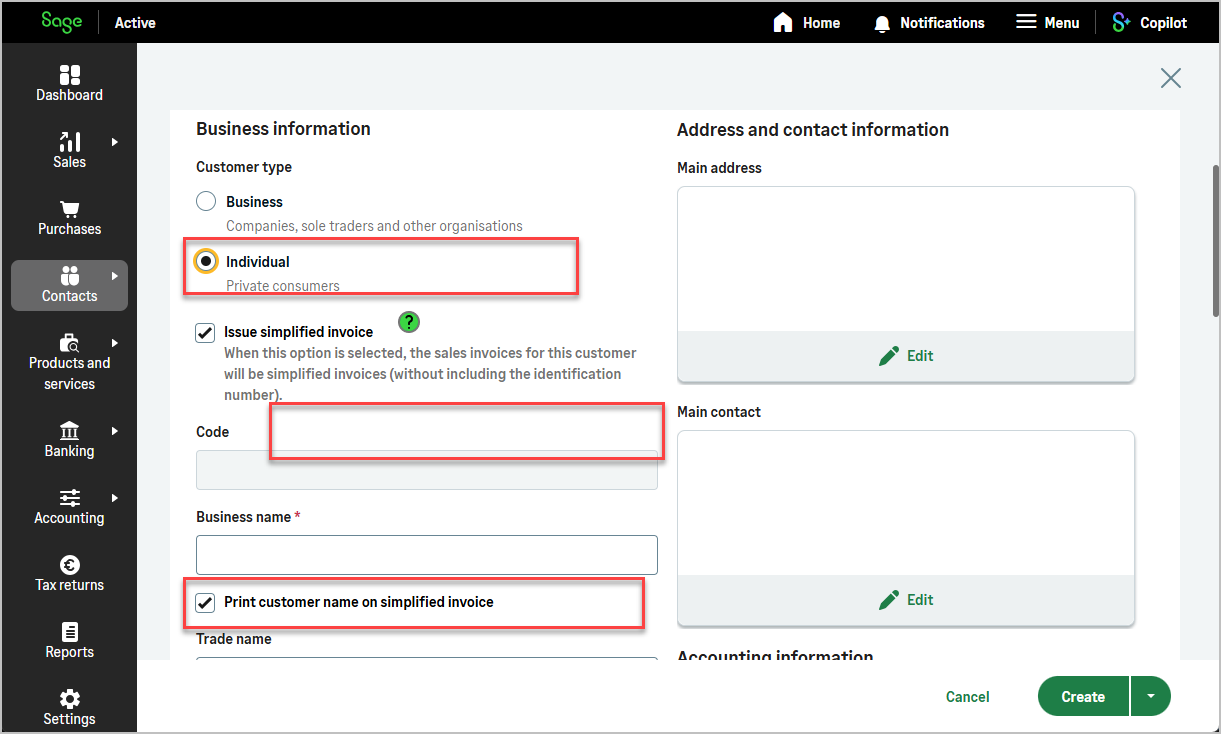
  • customerType is set to INDIVIDUAL (
    • BUSINESS
    • INDIVIDUAL
    ).
    UI: always visible on the customer form (all legislations).
  • nonIdentifiedCustomer is enabled on the customer.
    UI: visible only when customerType is INDIVIDUAL (ES legislation only).

When nonIdentifiedCustomer is selected, the sales invoices for this customer will be simplified invoices (without including the identification number).

printNameOnPdf defines whether the customer name is printed on the simplified invoice PDF by default when a new sales invoice is created for this customer.
UI: visible only when customerType is INDIVIDUAL (ES legislation only).

img

Sales Invoice setup

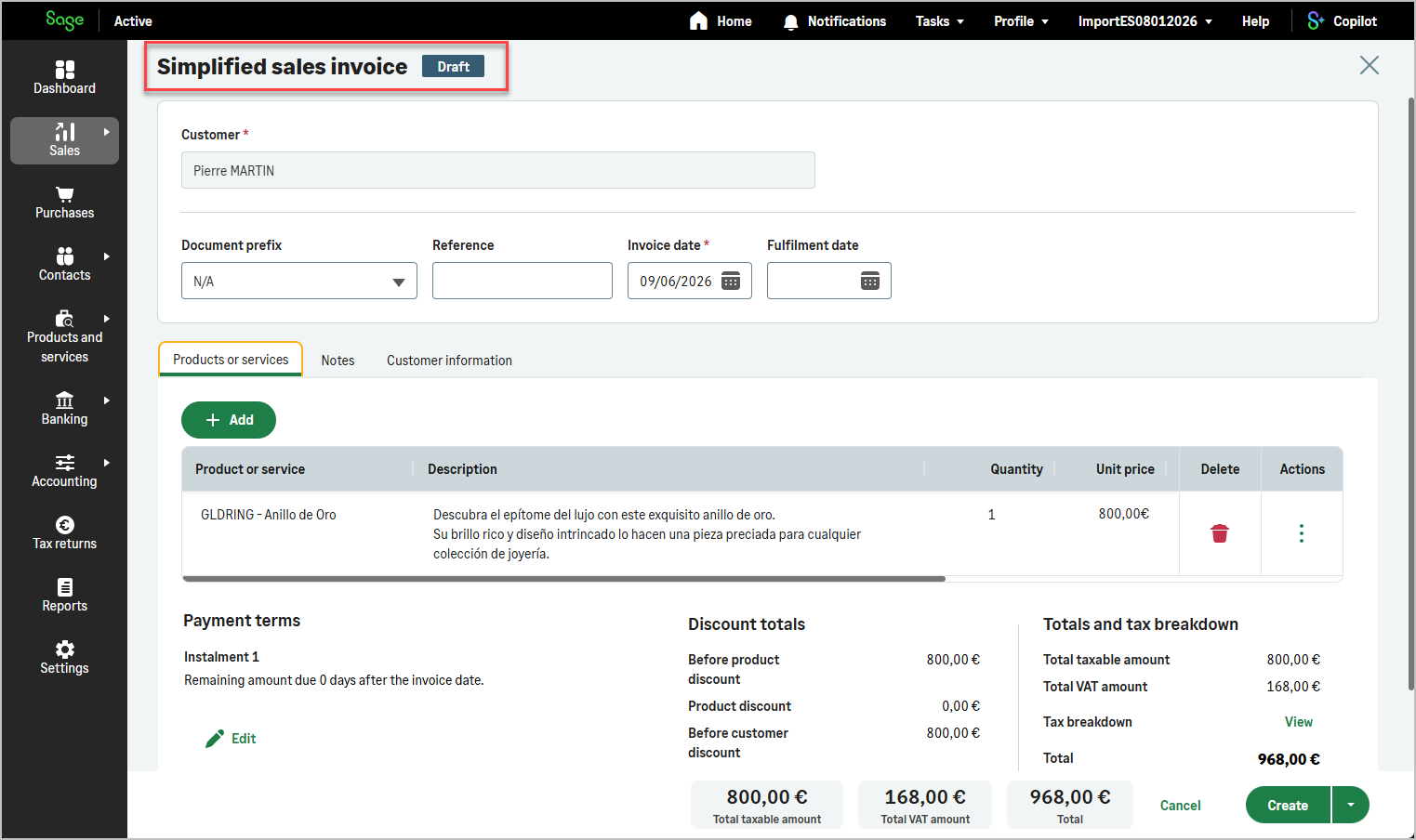
At the sales invoice level, there is no field to choose whether the document is a simplified invoice or a standard invoice.

Whether an invoice is treated as a simplified invoice is determined entirely by the customer used on the document:

  • If the customer meets the conditions described in Customer Setup (INDIVIDUAL and nonIdentifiedCustomer enabled), sales invoices created for that customer are simplified invoices.
  • Otherwise, the invoice follows the standard invoice rules.

When creating a sales invoice through the API, provide the customer (for example customerId on createSalesInvoice).
Sage Active applies the correct invoice type from the customer configuration.

printNameOnPdf controls whether the customer name is printed on the simplified invoice PDF for this document.
When true, the customer name appears on the PDF.
On creation, this value is pre-filled from the customer’s printNameOnPdf default and can be changed on the invoice if needed.
UI: visible only under ES legislation and when the invoice is a simplified invoice (customer with nonIdentifiedCustomer enabled).

Organization Setup

Organization-level settings are exposed on organizationSalesSetupByOrgId (ES legislation only):

These settings complement the per-customer nonIdentifiedCustomer option described above.

nonIdentifiedSalesInvoiceMaxAmount defines the amount above which Sage Active warns users when creating a simplified invoice (for example, 400 for the general €400 VAT-included limit mentioned in Spanish regulations).

When a simplified invoice is created, Sage Active can apply the document-number prefix from nonIdentifiedSalesInvoiceDefaultPresetTextId (instead of the standard sales invoice preset).
You can still override the prefix on the invoice with operationalNumberPresetTextId if needed.

Invoice Creation Rules

For a customer configured for simplified invoices (ES legislation, nonIdentifiedCustomer enabled), validation rules differ from a standard invoice:

  • documentId: For a Spanish customer, you need to fill a valid NIF/DNI/NIE number.
    The value is not mandatory.
    UI: always visible on the customer form; optional when the customer is set up for simplified invoices.
  • vatNumber: Not mandatory.
    UI: always visible on the customer form; optional when the customer is set up for simplified invoices.
  • addresses#CompanyAddress: Optional.
    UI: always visible on the customer form; optional when the customer is set up for simplified invoices.

Special Case: Customer Country and VAT

Even when the customer’s countryAcronym indicates a country different from the current legislation (for example, GB for an organization operating under ES legislation), Spanish VAT (IVA) still applies on simplified invoices.

On a standard invoice, VAT treatment may depend on whether the customer is in Spain, in the EU (VIES), or outside the EU.
A simplified invoice follows a different rule: it is intended for retail sales to final consumers where the recipient does not act as a business or professional. In that context, the applicable Spanish tax rate must still be shown on the document.

This is consistent with Spanish VAT invoicing rules and the AEAT VAT manual on simplified invoices:

  • A simplified invoice must include the applicable tax rate (tipo impositivo aplicado).
  • It is permitted only for qualifying domestic B2C retail operations (generally up to €400 VAT included, or up to €3,000 VAT included in specific sectors such as retail, hospitality, or transport).
  • It may not be issued for operations where a different VAT treatment would normally apply, such as intra-EU supplies of goods or transactions performed outside the European Union when the supplier is established in Spain.

In practice, relaxing customer identification on a simplified invoice does not exempt the transaction from Spanish VAT.
The customer’s countryAcronym does not change this behavior in Sage Active.

Creating a Simplified Invoice

Invoice creation uses the same createSalesInvoice mutation as for a standard invoice.

No specific product or line type is required.
Once the customer is configured for simplified invoices (ES legislation, INDIVIDUAL and nonIdentifiedCustomer), create the invoice as usual and optionally set printNameOnPdf on the invoice payload (API always accepts this field; the web application UI shows it only for simplified invoices under ES legislation, as described in Sales Invoice setup).